
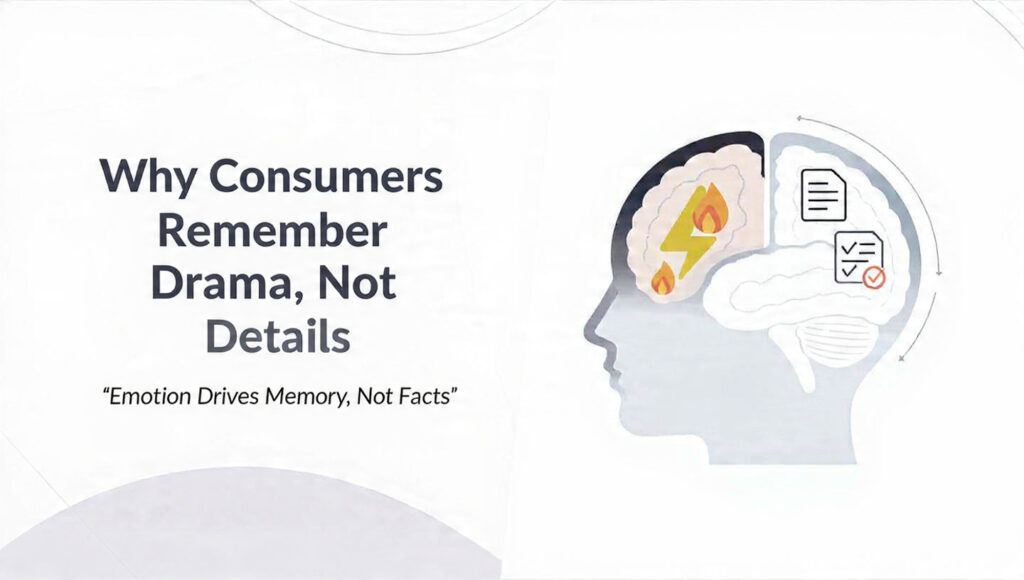
Introduction to Why Consumers Remember Drama, Not Details
Consumers rarely recall specifications, features, or rational arguments. They forget the fine print. Yet they vividly remember the drama. Because drama provokes emotion, it imprints itself on memory. Since drama feels alive, it overshadows details.
When brands embrace spectacle, they stop listing facts and start commanding attention. As a result, they provoke emotion, spark conversation, and convert audiences into loyal communities.
The Psychology of Why Consumers Remember Drama, Not Details
Emotion Dominates Memory
Emotion drives recall. Spectacle exaggerates emotion, embedding itself deeper than rational information. Consumers remember the gasp, the laugh, the shock — not the bullet points.
Storytelling Shapes Recall
Stories guide memory. Drama dramatizes narrative arcs, leading audiences through unforgettable journeys. Consumers recall the hero’s defiance, the villain’s downfall, the twist not the technicalities.
Surprise Jolts the Brain
Surprise hooks attention instantly. Drama thrives on shock, leaving audiences replaying the moment long after details fade.
The Science Behind Drama Over Details
Neurological Insights
- The amygdala prioritizes emotional experiences.
- Dopamine spikes during dramatic events.
- Emotional spikes override rational thought.
Behavioral Economics
- Distinctiveness bias ensures odd campaigns stand out.
- Information overload blurs details, while drama cuts through.
- Anchoring effect inflates perceived value when tied to spectacle.
Historical Roots of Drama in Branding
Oddness and spectacle have always dominated memory.
- Punk fashion in the 1970s dramatized rebellion.
- Guerrilla marketing in the 1980s exaggerated disruption.
- Viral stunts in the 2000s blurred art and advertising.
- Social media chaos today proves drama dominates feeds.
Examples of Why Consumers Remember Drama, Not Details
Apple’s Launch Theatre
Apple dramatizes launches with theatrical events. Consumers remember the spectacle, not the processor specs.
Nike’s Defiance
Nike dramatizes ambition with “Just Do It.” Consumers remember the defiance, not the shoe material.
Patagonia’s Rebellion
Patagonia dramatizes honesty with “Don’t Buy This Jacket.” Consumers remember the rebellion, not the stitching.
Supreme’s Frenzy
Supreme dramatizes chaos with unpredictable drops. Consumers remember the frenzy, not the fabric.
Red Bull’s Adrenaline Theatre
Red Bull dramatizes adrenaline with extreme sports. Consumers remember the spectacle, not the beverage formula.
Benetton’s Shock Advertising
Benetton dramatized social issues with shocking imagery. Consumers remember the controversy, not the catalog.
Duolingo’s Owl Antics
Duolingo dramatizes oddness with absurd TikTok skits. Consumers remember the comedy, not the app’s grammar rules.
How Brands Use Drama Strategically
Shock Campaigns
Shock provokes emotion. Consumers remember the jolt, not the fine print.
Scarcity Campaigns
Scarcity dramatizes urgency. Consumers remember the panic, not the policy.
Lifestyle Campaigns
Lifestyle dramatizes aspiration. Consumers remember the dream, not the detail.
Humor Campaigns
Humor dramatizes oddness. Consumers remember the laugh, not the logic.
Framework: Harnessing Drama Over Details
Steps to Implement Drama Strategically
- Identify emotional triggers.
- Amplify drama deliberately.
- Balance spectacle with clarity.
- Stage campaigns as theatre.
- Measure emotional impact.
Risks of Overusing Drama
Excessive Spectacle
Too much drama feels chaotic. Consumers disengage.
Miscommunication
Drama exaggerates meaning. Misuse sends wrong signals.
Alienation
Drama feels niche. Mainstream audiences risk exclusion.
The Odd Boss Philosophy
Odd bosses don’t list specs. They dramatize emotion. Safe branding feels predictable. Drama feels alive. People follow energy. Spectacle wins.
Drama is not failure. It is strategy. It is rebellion. It is theatre. When brands embrace it, they stop whispering and start commanding attention.
Conclusion: Why Consumers Remember Drama, Not Details
Consumers do not carry home the bullet points. They carry home the fireworks. They don’t replay the technicalities in their minds; they replay the theatre. Drama is the thunderclap that shakes memory, the lightning bolt that burns itself into imagination. Details are dust. Drama is destiny.
When brands embrace spectacle, they don’t just sell they hypnotize. They don’t just persuade they possess. They don’t just inform they ignite. Audiences will forget the numbers, the charts, the rational arguments. But they will remember the gasp, the laugh, the shock, the roar.
Drama is not decoration. It is the weapon. It is the crown. It is the empire. Brands that dare to stage drama become unforgettable legends, while those clinging to details vanish into silence.
Contact Us
Partner with My Odd Boss to craft branding strategies that shock, seduce, and dominate. Let’s turn your campaigns into performances audiences will never forget.
Why Consumers Remember Drama, Not Details
1. The Hero’s Entrance
Imagine a brand campaign like a movie scene: the hero bursts through the door, lights flashing, music swelling. Consumers don’t recall the exact shade of the hero’s jacket but they do remember the dramatic entrance.
Takeaway: Big, theatrical moments imprint on memory more than fine-grained information.
2. The Villain’s Twist
A shocking plot twist—like a villain revealing their true face makes audiences gasp. They won’t remember the villain’s dialogue word-for-word, but they’ll never forget the betrayal.
Takeaway: Surprise and conflict create emotional spikes that anchor memory.
3. The Comic Relief Scene
Think of a quirky character who steals the spotlight with exaggerated humor. People retell the joke at parties, but no one recalls the exact script.
Takeaway: Entertainment value trumps precision; laughter is more memorable than lines.
4. The Climactic Showdown
In a film’s finale, the clash of hero vs. villain is unforgettable. Consumers remember the feeling of tension and release, not the technical details of the fight choreography.
Takeaway: Emotional highs and lows are sticky; details dissolve in the background.