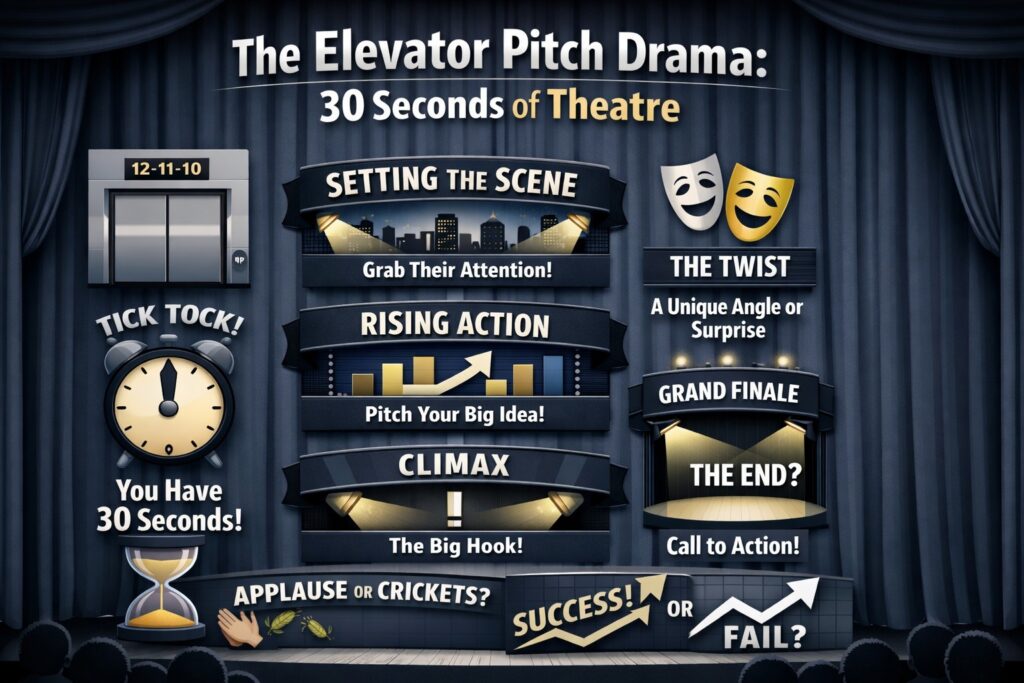
The Elevator Pitch Drama: 30 Seconds of Theatre
Elevators are not just metal boxes; instead, they are theatres of opportunity. Because time is short, every second matters. While ordinary professionals whisper credentials, odd bosses dramatize presence. Consequently, the elevator pitch becomes not a summary but a performance.
Odd bosses don’t settle for bland introductions; rather, they exaggerate identity. Therefore, the elevator pitch is not about facts; instead, it is about theatre.
Scene One: The Doors Close, The Curtain Rises
The elevator doors shut, and silence fills the space. Because tension rises instantly, the Odd Boss seizes the moment. Instead of reciting a dull script, they deliver a dramatic opening line. Consequently, the listener leans in, curious and captivated.
Although the ride is short, the Odd Boss treats it like a stage. Therefore, the pitch begins not with data but with drama.
Scene Two: The 30-Second Performance
Because brevity magnifies impact, the Odd Boss crafts every word deliberately. Instead of listing achievements, they tell a story. Consequently, the listener remembers the narrative, not the resume.
While others rush through facts, the Odd Boss pauses for effect. Therefore, the pitch feels less like information and more like theatre.
Scene Three: The Dramatic Twist
Surprise jolts the brain, and the Odd Boss thrives on shock. Because audiences expect routine, the Odd Boss delivers oddness. For instance, they might say: “We don’t sell products; we stage rebellions.” Consequently, the listener laughs, remembers, and asks for more.
Although the pitch lasts only 30 seconds, the Odd Boss ensures it feels like a cliffhanger. Therefore, the listener leaves wanting the sequel.
The Psychology of Elevator Pitch Theatre
Emotion Drives Recall
Because emotion fuels memory, odd bosses amplify drama deliberately. Therefore, audiences remember the gasp, the laugh, the shock, and the roar rather than the technical detail.
Identity Fuels Belonging
Odd bosses dramatize personality. Consequently, audiences rally behind leaders who feel eccentric, theatrical, and authentic rather than faceless professionals.
Surprise Fuels Virality
Surprise jolts the brain, and odd bosses thrive on shock. Therefore, audiences replay the twist long after the elevator ride ends.
The Science of Elevator Pitch Drama
Because dopamine spikes during novelty, listeners feel rewarded. Moreover, the amygdala prioritizes emotional experiences, so odd pitches dominate recall. Consequently, emotional arousal strengthens synaptic connections, and memory becomes durable.
Distinctiveness bias ensures odd pitches stand out, while social proof attracts followers when oddness goes viral. Therefore, elevator pitch theatre becomes business gold.
Case Studies: Odd Elevator Pitches That Worked
The Rebel’s Pitch
One Odd Boss opened with: “We don’t sell coffee; we sell chaos in a cup.” Because the line was unforgettable, the listener asked for a meeting immediately.
The Storyteller’s Pitch
Another Odd Boss told a 20-second story about a customer’s transformation. Since stories magnify emotion, the pitch became memorable. Consequently, the deal closed.
The Shock Pitch
A third Odd Boss began with humor: “We’re the brand your competitors warn you about.” Because surprise magnified curiosity, the listener leaned in. Therefore, the pitch succeeded
Framework: How to Deliver Odd Elevator Pitch Theatre
- Open with Drama — Because first impressions matter, odd bosses dramatize openings.
- Tell a Story — Since stories magnify emotion, odd bosses use narrative.
- Add Surprise — Therefore, odd bosses deliver twists.
- Use Odd Language — Because oddness magnifies recall, odd bosses exaggerate tone.
- End with Cliffhanger — Consequently, odd bosses leave listeners wanting more.
Risks of Elevator Pitch Oddness
Too much oddness feels chaotic. Consequently, audiences disengage. Miscommunication exaggerates meaning; therefore, misuse sends wrong signals. Oddness feels niche; however, mainstream audiences risk exclusion if not balanced.
The Odd Boss Philosophy: Owning the Elevator Pitch
Odd bosses don’t chase invisibility. Instead, they dramatize rebellion. Although safe pitches feel predictable, odd pitches feel alive. Because people follow energy, spectacle becomes empire.
Elevator pitches are not failure. They are strategy. They are rebellion. They are theatre. When businesses embrace oddness, they stop whispering and start commanding attention.
Conclusion: The Elevator Pitch Drama
Audiences don’t remember the quiet introduction; instead, they remember the outrageous line. They don’t replay the resume in their minds; rather, they replay the theatre. Elevator pitches transformed by odd bosses are the thunderclap that shakes memory, the lightning bolt that burns itself into imagination, the tidal wave that sweeps away conformity, the earthquake that cracks open tradition, and the wildfire that consumes mediocrity.
When odd bosses deliver elevator pitches, they don’t just introduce — they hypnotize. They don’t just persuade — they possess. They don’t just inform — they ignite. Audiences will forget the numbers, the charts, the rational offers. However, they will remember the gasp, the laugh, the shock, and the roar.
Elevator pitch oddness is not decoration. It is the weapon. It is the crown. It is the empire. Leaders that dare to stage oddness in 30 seconds become unforgettable legends, while those clinging to safety vanish into obscurity. Odd bosses do not fuel growth quietly; instead, they detonate it. They do not whisper opportunity; rather, they scream empire.
The Elevator Pitch Drama: 30 Seconds of Theatre
An elevator pitch isn’t just a summary—it’s a performance. You have 30 seconds, the length of a scene, to capture attention, spark emotion, and leave a lasting impression. Odd Boss turns this into theatre with a step‑by‑step activity.
1. Act One: The Dramatic Entrance
Activity: Stand up, imagine the elevator doors opening, and practice your first line as if it’s a stage cue.
Example: Instead of “Hi, I’m Juveriya,” try: “Imagine a brand so odd it steals the spotlight—that’s what I build.”
Transition: As a result, your pitch begins with energy, not routine.
2. Act Two: The Villain Setup
Activity: Identify the “villain” your business defeats—boredom, sameness, forgettable branding. Say it out loud with exaggeration.
Example: “Most brands drown in the sea of sameness. My Odd Boss slays that villain with drama.”
Transition: Consequently, your audience instantly knows the problem you solve.
3. Act Three: The Hero Reveal
Activity: Position yourself as the hero. Use bold, theatrical language to show how you rescue clients.
Example: “I don’t just design campaigns—I stage performances that audiences never forget.”
Transition: In contrast, ordinary pitches fade into background noise.
4. Act Four: The Shock Line
Activity: Add one unforgettable, surprising statement. Practice saying it with emphasis.
Example: “Professionalism is boring—oddness is the new credibility.”
Transition: Therefore, your pitch sticks in memory like a headline.
5. Act Five: The Carnival Mirror
Activity: Exaggerate your impact. Stretch reality just enough to be memorable.
Example: “My campaigns don’t just trend—they hijack culture.”
Transition: As a result, your pitch feels larger‑than‑life.
6. Act Six: The Emotional Anchor
Activity: Tie your pitch to a feeling—joy, pride, excitement. Practice saying it with emotion.
Example: “I make brands feel like festivals—alive, colorful, unforgettable.”
Transition: Moreover, emotion makes your pitch unforgettable.
7. Act Seven: The Joyful Break
Activity: Insert humor or playfulness. Add a quirky metaphor or playful exaggeration.
Example: “Think of me as your brand’s director—I don’t just market, I choreograph applause.”
Transition: Consequently, your pitch feels fun, not forced.
8. Act Eight: The Standing Ovation
Activity: End with a powerful finale. Practice saying it like a curtain call.
Example: “In 30 seconds, I’ve shown you theatre. Imagine what I can do in 30 days.”
Transition: Ultimately, you leave the stage with applause, not silence.
🎤 Final Bow
The elevator pitch isn’t about cramming information—it’s about staging drama. Odd brands know that in 30 seconds, you can either be forgettable or unforgettable.
.